

Kitchen worktop installation is the moment your renovation stops being a plan and starts being a kitchen, yet most homeowners walk into the day knowing almost nothing about what will actually happen. That is not their fault. Most of the advice online reads like it was written by someone who has never carried a 250 kilogram slab of quartz through a hallway. It tells you to “clear the area” and “expect some noise” and leaves out everything that genuinely matters: why your base units need checking before the fitters arrive, why you cannot use your new sink for 24 hours, and why the gap between templating and fitting exists at all.
At Meridian Granite, we have completed more than 15,000 kitchen projects across Yorkshire and the wider UK, so we know exactly where installation days run smoothly and exactly where they go wrong. This guide walks you through the full process honestly, including the parts other companies tend to gloss over.
The Industry Reality: Why Worktop Installation Is Not a One Day Job
Here is the first thing that surprises most homeowners: professional stone worktop installation is a two visit process, and the visits are usually five to ten working days apart.
The first visit is templating. A technician creates a precise digital template of your kitchen, typically using laser measuring equipment, capturing every wall angle, every unit run, and the exact positions of your sink, hob and appliances. Walls are rarely straight and corners are rarely 90 degrees, particularly in older Yorkshire terraces and Victorian properties. The template captures reality, not the drawing.
The second visit is the installation itself, once your granite or quartz worktops have been cut, polished and finished at the fabrication workshop.
This gap catches people out constantly. Renovators plan their kitchen around a single fitting date, then discover their old worktops need to come out before templating and they will be without a full working kitchen for a week or more. If you are planning a kitchen renovation, build that window into your schedule from the start. Plan a temporary washing up station, keep the kettle and microwave accessible, and you will find the wait far less painful.
What Actually Matters Before the Fitters Arrive
Most installation problems are created before the installation team ever knocks on the door. These are the things that genuinely determine whether your day goes smoothly.
Your base units must be fitted, level and permanent
Stone worktops are templated to your kitchen exactly as it stands. If your cabinets move, get adjusted or get swapped after templating, the worktops will not fit. It sounds obvious, but it is the single most common cause of failed installations across the industry. Units need to be fully fixed to the wall, level to within a couple of millimetres across each run, and structurally capable of carrying the weight. A typical 30mm granite worktop weighs around 80 to 90 kilograms per square metre. Flat pack units in good condition handle this without issue, but damaged or unsecured cabinets will not.
Sinks, hobs and taps need to be on site at templating
The templating technician does not just measure your room. They measure your appliances. An undermount sink cut-out is machined to the exact model of sink, with a precise reveal around the bowl. A hob cut-out needs the manufacturer’s specified clearances. If your sink arrives after templating, the fabricator is cutting blind, and that is how you end up with an overhang that looks wrong or a hob that does not sit flush. Have every item that touches the stone physically in the property on templating day.
Services need to be disconnected
Installation teams fit stone. They are not usually plumbers or Gas Safe engineers. Your existing worktops should be removed, your sink disconnected, and any gas hob capped off by a registered engineer before the fitting date. Some companies, including Meridian Granite, can advise on sequencing here, but the legal responsibility for gas work always sits with a Gas Safe registered professional. Booking your plumber for the day after installation, once silicone has had time to cure, is the sequencing that experienced kitchen fitters use.
Access is a bigger deal than you think
A three metre run of quartz cannot bend around a tight staircase. Fitters carry slabs vertically on edge, so they need clear, wide access from the vehicle to the kitchen. Move cars off the drive, take pictures off hallway walls, roll up runners, and mention anything unusual, such as steps, gravel paths or narrow doorways, when booking. If access is genuinely restricted, the fabricator can often plan joint positions to split long runs into manageable sections, but they can only do that if they know in advance.
What Happens on Installation Day, Hour by Hour
A typical kitchen worktop installation takes between two and five hours depending on the size of the kitchen and the number of cut-outs. Here is the realistic sequence.
Arrival and dry fit. The team carries each piece in and rests it in position without fixing anything. This is the moment they check the template against reality one final time. Small scribing adjustments to walls are normal and nothing to worry about.
On-site finishing. Some cutting and polishing happens in your home no matter how good the fabrication is. Tap holes are often drilled on site, and joints are shaped for a perfect fit. This creates dust and noise. Good installers use dust extraction and wet cutting outdoors where possible, but a stone installation is not a silent, dust-free event and anyone who promises otherwise is overselling.
Fixing and jointing. Pieces are bonded to the units with flexible adhesive, and joints between slabs are filled with a colour-matched epoxy resin, clamped, and polished back. On a well-executed quartz worktop installation, a joint should be tight, level and visible only on close inspection. It will never be invisible, and any installer who claims their joints disappear entirely is setting you up for disappointment. What you should expect is a joint positioned intelligently, away from sink cut-outs where possible, since stone is weakest around cut-outs and a joint through that area creates a stress point.
Undermount sink bonding. If you have chosen an undermount sink, it is bonded and mechanically supported beneath the stone. This is precision work and one of the clearest markers of installer quality.
Sealing and cleaning. Granite worktop installation ends with sealing, because granite is naturally porous and needs a penetrating sealer to resist staining. Quartz is non-porous and needs no sealing, which is one of the practical differences worth understanding when comparing stone worktops. The team then cleans down, walks you around every surface, and asks you to inspect joints, cut-outs and edges before they leave. Do this properly. Run your hand along the edges, look at the joints in natural light, and raise anything immediately rather than after the van has gone.
The 24 Hours After Installation
This is the part almost nobody explains, and it causes more avoidable problems than anything else.
Adhesives and silicone need time to cure. For the first 24 hours you should avoid heavy loads on the worktops, avoid leaning on overhangs, and critically, avoid running water into an undermount sink. The bond holding that sink is strong once cured, but water finding its way into uncured silicone can compromise the seal permanently. Book your plumber for the following day, not the same afternoon.
You should also expect a faint resin smell from joint adhesive for a day or so, and a small amount of settling dust to reappear even after cleaning. Both are normal.
A Real Scenario: The Leeds Renovation That Nearly Went Wrong
A recent project in north Leeds illustrates almost everything in this article. The homeowners were mid-renovation, with a kitchen fitter, an electrician and a plasterer all working to a tight schedule. Templating was booked, but on the day the induction hob had not arrived and one run of base units was still loose because the fitter planned to “fix them properly later”.
Templating went ahead on the fitted sections only, with a return visit arranged for the hob run once the units were fixed and the appliance was on site. That added four days to the project. Frustrating, but the alternative was worse: templating loose units means fitting stone to a kitchen that no longer exists by installation day, and a hob cut-out based on a guess.
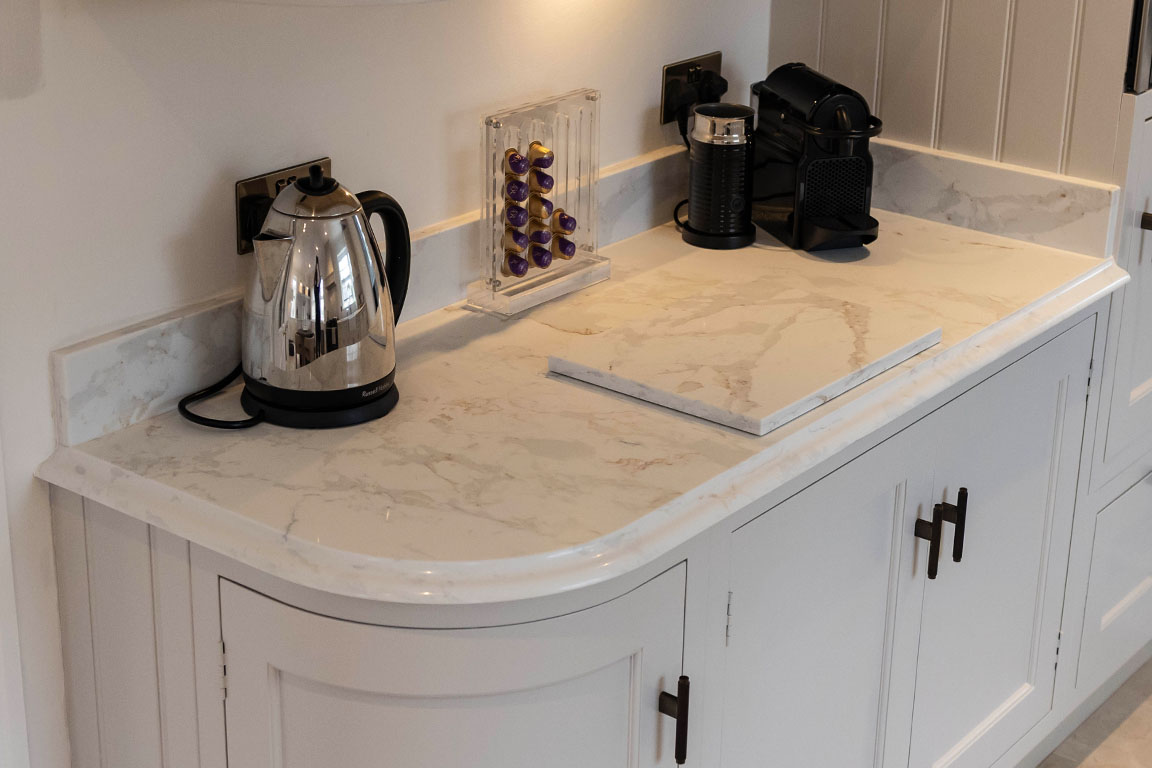
The finished installation, a full Calacatta-style quartz kitchen with a mitred waterfall end panel, fitted first time with no adjustments. The four day delay protected a five figure investment. That trade-off is worth understanding before your own project reaches the same fork in the road.
The Insight Layer: Questions Worth Asking Any Installer
If you take nothing else from this article, take these questions. The answers separate genuine stone specialists from middlemen who subcontract fabrication.
Who fabricates the stone? Companies that fabricate in-house, as we do at our Pudsey workshop, control quality, timescales and remedial work directly. Companies that outsource are negotiating with a third party every time something needs correcting.
Where will the joints be? A good installer discusses joint positions with you before fabrication, not on the day. Fewer joints generally means better aesthetics but harder access, so this is a genuine design conversation.
What edge profile and what overhang? These details are decided at templating, not installation. If nobody has asked you, that is a warning sign.
What happens if a piece is damaged in transit or fitting? Stone occasionally breaks. The honest answer involves refabrication timescales, not vague reassurance.
Is the quote fully inclusive? Cut-outs, drainer grooves, tap holes, upstands and sealing should all be itemised. Vague quotes grow.
Why This Matters When Choosing Between Granite, Quartz and Sintered Stone
Installation is not identical across materials, and it should influence your choice. Granite requires sealing on the day and periodic resealing over its life. Quartz worktops need no sealing but are more sensitive to heat during on-site polishing, so experienced handling matters. Dekton and other sintered surfaces are exceptionally hard, which makes them superb in use but far less forgiving during cutting and fitting, so they should only ever be installed by teams with specific experience of the material.
This is why kitchen worktops in the UK are increasingly supplied and fitted by the same specialist rather than bought as slabs and handed to a general kitchen fitter. The fabrication and the installation are two halves of the same craft.
How Meridian Granite Handles Installation
Everything in this article reflects how we actually work. Meridian Granite is a family-run stone specialist based in Pudsey, Leeds, and we manage the entire process in-house: laser templating, CNC fabrication in our own workshop, and installation by our own teams, with nationwide coverage from our Yorkshire base. Because nothing is subcontracted, the person who templates your kitchen and the team who fit your stone are working from the same information, to the same standard, under the same roof.
If you are planning a kitchen renovation and want to see materials properly before deciding, our showroom holds full slabs of granite, quartz, Dekton and exotic quartzite rather than small samples, because a 100mm square never tells you how a veined stone will actually look across three metres of worktop.
The Bottom Line
A kitchen worktop installation goes smoothly when the groundwork is done properly: units fixed and level, appliances on site for templating, services disconnected in advance, access cleared, and a realistic 24 hour cure window respected afterwards. The fitting itself, in experienced hands, is the easy part.
If you are ready to plan your installation, or you simply want honest answers about timescales, materials and costs before committing, speak to the team at Meridian Granite. We will tell you what your project genuinely involves, including the parts that are less convenient to hear, because that is what 15 years in this trade has taught us matters most.
Book your templating appointment or visit our Pudsey showroom via meridiangranite.com.