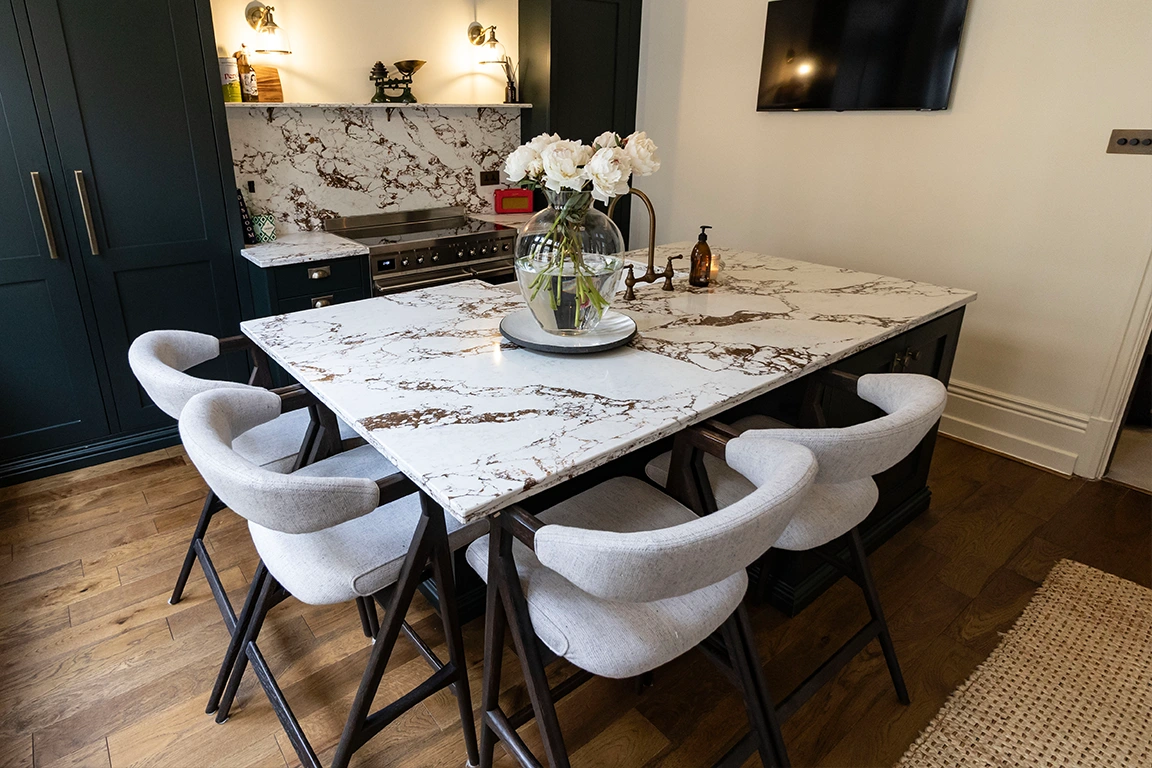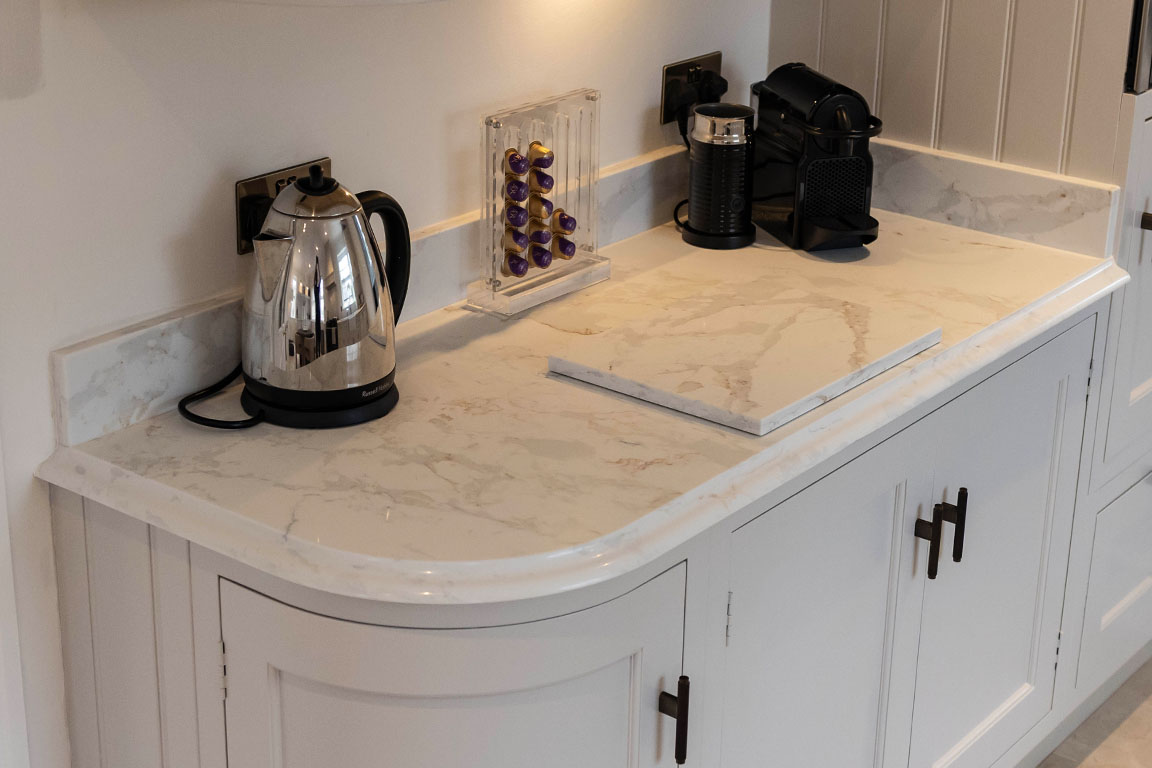


Quartz worktops look their absolute best on a kitchen island, which is exactly why islands expose every shortcut in planning and fabrication. On a run of base units, a compromise can hide against a wall. On an island, the worktop is visible from every side, at every angle, in the best light in the room. Getting it right starts long before the stone is cut, with four things most homeowners have never been asked to think about: slab sizes, joins, overhangs and support.
Here is what each one means for your design, and the questions worth settling before you sign off a quote.
Slab Sizes: The Number That Shapes Everything
Quartz arrives from the manufacturer as a slab, and slabs have limits. A standard slab measures roughly 3000mm by 1400mm, while jumbo formats from brands such as Silestone and Caesarstone stretch to around 3200mm by 1600mm.
Those numbers matter because they decide whether your island can be cut from a single piece. An island of 2400mm by 1200mm fits comfortably within one jumbo slab. Push the design to 3400mm long, or wider than 1600mm, and a join becomes unavoidable no matter who fabricates it.
This is why island dimensions are worth discussing with your fabricator at design stage rather than after the cabinetry is ordered. A 100mm change on a drawing can be the difference between seamless stone and a visible join, and it costs nothing to make that change on paper.
Joins: Where Skill Shows
Sometimes a join is unavoidable, and a well-made one is nothing to fear. The difference between a join you notice and one you forget exists comes down to three fabrication decisions:
- Placement. Good fabricators position joins away from sightlines and focal points, never centred in the main approach to the island, and ideally aligned with a hob edge, sink edge or design break.
- Pattern matching. On veined, marble-effect quartz, the two pieces should be cut so the pattern flows across the join rather than colliding at it. This takes more material and more care, which is why cheap quotes rarely include it.
- Colour-matched bonding. The adhesive should be tinted to the stone, tightly clamped and finished flush.
Ask any prospective supplier where the join will fall on your island and how they will handle the veining. The quality of the answer tells you a great deal.
Overhangs: The Breakfast Bar Question
Most islands include seating, and seating means an overhang. The comfortable depth for knees is around 300mm, and this is precisely where quartz needs engineering rather than optimism.
As a general rule, 20mm quartz can overhang unsupported to roughly 250mm, and 30mm to around 300mm, provided the rest of the piece is well anchored. Beyond that, the stone needs support, because quartz is strong under compression but unforgiving under flex. An unsupported 400mm overhang might survive years of quiet use, then fail the day someone leans on it or a child climbs up.
Support: Invisible When Done Properly
The good news is that supporting an overhang no longer means bulky corbels, unless you want them for a traditional look. The usual solution is flat steel bars recessed into the cabinet top, extending under the stone and completely invisible once fitted. For very deep overhangs or floating designs, steel legs or a framework do the work instead.
Support is a detail worth confirming in writing on your quote. It is inexpensive during installation and awkward to add afterwards, and its absence is one of the most common faults we see when asked to assess islands fitted by others.
Waterfall Ends and Statement Details
Islands are where design features earn their keep. Waterfall ends, where the quartz flows vertically to the floor, rely on precise mitred joints and careful pattern continuation down the face. Book-matched veining, deep mitred edges and integrated drainer grooves all belong in the same conversation. Each one depends more on workshop skill than on the brand of quartz, so ask to see examples in the flesh before committing.
Planning an Island in West Yorkshire
Meridian Granite templates, fabricates and installs island worktops from our workshop in Pudsey, Leeds, working across West Yorkshire and nationwide. Our showroom holds full slabs in standard and jumbo formats, so you can check whether your island fits a single piece and see exactly how veining will flow across it. We handle the steelwork for overhangs in-house, and after more than 15,000 projects we can usually spot an island design problem on a drawing in minutes, while it is still free to fix.
Final Thoughts
A great island worktop is a piece of engineering wearing a beautiful surface. Settle the slab size early, plan joins deliberately, respect the overhang limits and put the support in writing. Do those four things and your island will look effortless, which is the whole point.
Looking for Quartz Worktop Suppliers?
If you’re comparing quartz worktop suppliers, speak to Meridian Granite about your kitchen island. Send us your plans or request a quote today.