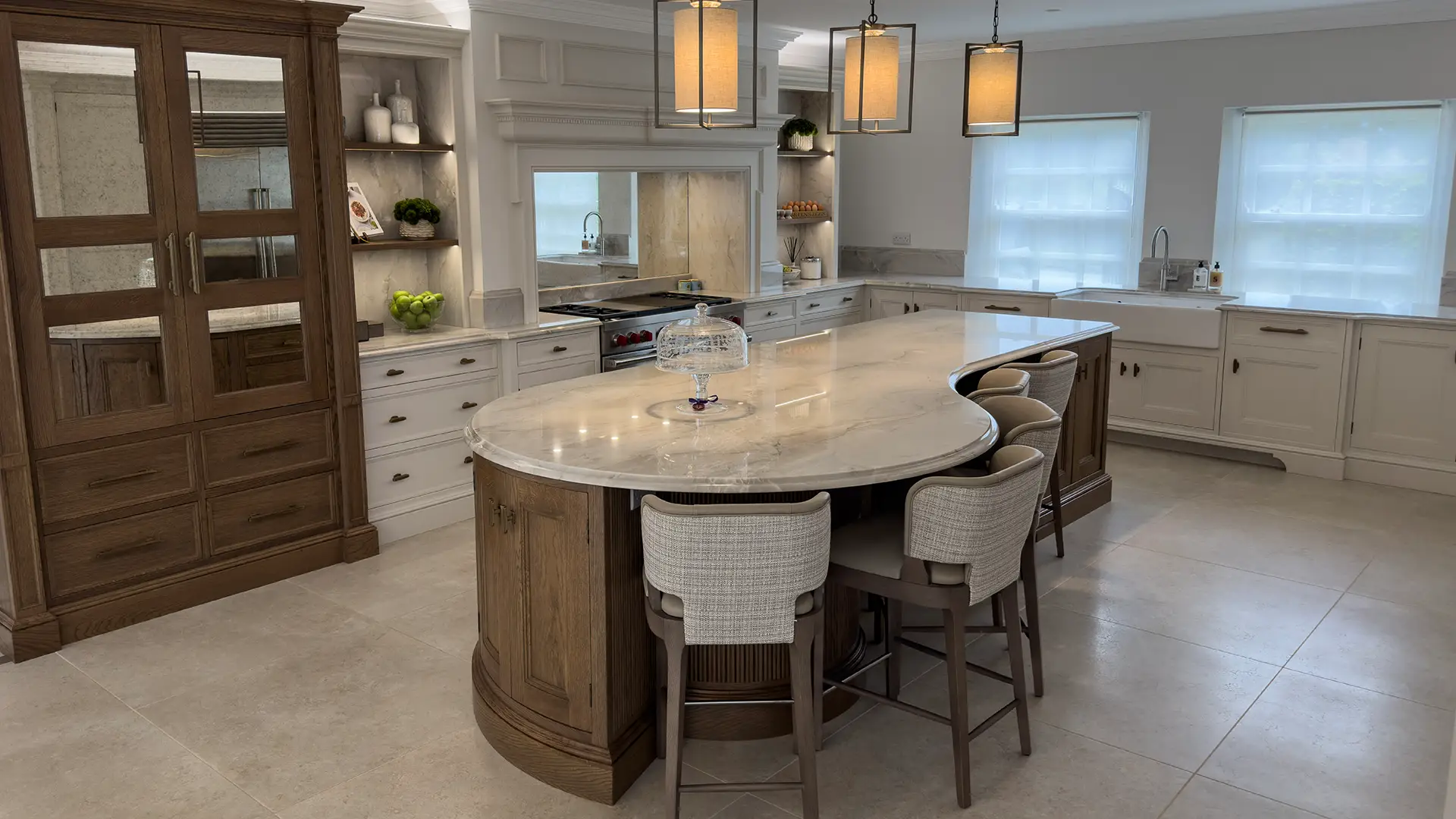


Most advice about choosing granite worktops in the UK focuses on colour charts, price brackets and durability ratings, yet it skips the one factor that determines how your worktop will actually look every single day: your kitchen lighting. Two homeowners can order the same granite slab, from the same quarry, cut from the same block, and end up with kitchens that look completely different. One worktop appears warm, rich and full of depth. The other looks flat, grey and lifeless. The stone did not change. The light did.
If you are investing in natural stone worktops, understanding how light interacts with granite is not a design detail. It is the difference between a kitchen you love and a kitchen that never quite looks the way you imagined. This guide explains exactly how to assess your kitchen lighting, what it means for slab selection, and how to test granite properly before you commit.
Why Kitchen Lighting Matters When Choosing Granite Worktops in the UK
Granite is not a printed surface. It is a crystalline natural stone, and those crystals reflect, absorb and scatter light in ways that manufactured materials simply do not. Quartz content adds sparkle under direct light. Feldspar creates soft colour shifts. Mica flecks catch spotlights and can make a surface shimmer or glare depending on the angle.
This is why granite kitchen worktops behave so differently from showroom to home. Showrooms are usually lit with bright, high colour rendering lighting designed to flatter stone. Your kitchen is lit by a mixture of daylight through windows, ceiling spotlights, pendants and under-cabinet strips, all with different colour temperatures and intensities.
In the UK specifically, this matters more than most guides admit. British daylight is frequently overcast, diffused and cooler in tone than the light used in glossy brochure photography. A granite slab chosen under warm showroom lighting can read noticeably greyer and cooler in a typical Yorkshire kitchen in November. If you choose your slab without accounting for this, you are effectively buying blind.
Natural Light: What Your Kitchen’s Aspect Tells You
Before you look at a single slab, work out which direction your kitchen windows face. This single piece of information should shape your shortlist.
North-facing kitchens
North-facing kitchens in the UK receive consistent but cool, bluish light with little direct sun. This light flattens warm tones and exaggerates grey and blue undertones in stone.
What works: granites with warm undertones such as golds, creams, browns and warm greys help counteract the coolness. Stones with strong crystal content also perform well because they make the most of limited light.
What to be careful with: very dark granites with matte or honed finishes can absorb what little light is available and make the room feel smaller. Cool grey granites can tip into looking cold and clinical.
South-facing kitchens
South-facing kitchens enjoy strong, warm light for much of the day. This is the most forgiving aspect and the widest range of granite slabs will look good here.
The consideration people miss is glare. A highly polished black or dark green granite in a south-facing kitchen with large glazing can produce intense reflections in the afternoon. A honed or leathered finish tames this while keeping the depth of colour.
East and west-facing kitchens
East-facing kitchens receive cool morning light and dimmer afternoons. West-facing kitchens do the opposite, with warm, low, golden light in the late afternoon that can dramatically intensify red, pink and amber tones in stone.
If your kitchen faces west and you are considering a granite with pronounced warm veining, view a sample in that late afternoon light before deciding. Stones that look subtle at midday can become surprisingly bold at 5pm.
Artificial Lighting: Colour Temperature Changes Everything
Once the sun goes down, your granite worktop lives under artificial light, and in a UK winter that can be the majority of the time you actually see it. Two factors matter here.
Colour temperature
Lighting is measured in kelvins. Warm white bulbs sit around 2700K and cast a golden light. Cool white bulbs sit around 4000K and above, casting a whiter, bluer light.
Warm lighting enriches browns, golds and creams but can make grey and white granites look slightly yellowed. Cool lighting keeps whites and greys crisp but can make warm stones appear dull. If your kitchen uses 2700K spotlights and you choose a slab under 4000K showroom lighting, you will not get the colour you thought you bought.
Colour rendering
The colour rendering index, or CRI, measures how accurately a light source shows colour. Cheap LED spotlights with a low CRI can visibly deaden the character of natural stone worktops, muting veining and flattening depth. If you are spending on granite, specifying bulbs with a CRI of 90 or above is one of the cheapest upgrades you can make to how your kitchen looks.
Under-cabinet lighting
Under-cabinet LED strips light granite at a raking angle, skimming across the surface rather than hitting it from above. This does two things. It reveals the full crystal structure and movement in the stone, which can be stunning, and it also highlights surface texture, which matters enormously for your choice of finish.
Finish Selection: Polished, Honed or Leathered
Kitchen lighting should directly influence which finish you choose, not just which colour.
Polished granite reflects the most light. In darker kitchens it acts almost like a mirror, bouncing light back into the room and making the space feel brighter. In very bright kitchens, particularly under rows of ceiling spotlights, it can create hotspots and glare on the worktop surface.
Honed granite has a smooth matte finish. It eliminates glare and gives a softer, more contemporary look, but it reflects less light, so in a dim north-facing kitchen a honed dark granite can feel heavy.
Leathered granite has a gently textured finish that scatters light rather than reflecting it. Under raking under-cabinet light it shows beautiful surface character. It is a strong choice for busy kitchens because it also disguises fingerprints and water marks better than polish.
A practical rule of thumb from our fabrication work: the darker your kitchen, the more a polished finish earns its keep. The brighter and more heavily glazed your kitchen, the more a honed or leathered finish will reward you.
How Colour and Pattern Behave Under Different Light
Some specific behaviours worth knowing before you shortlist granite slabs:
Black granites with crystal content, such as Star Galaxy with its copper flecks or Blue Pearl with its iridescent feldspar, are transformed by directional lighting. Under spotlights they sparkle and shift as you move around the kitchen. Under flat, diffused light they can read as plain dark surfaces. If your kitchen relies mainly on one central pendant, you will see very little of what you paid for.
Heavily veined granites show their movement best under even, bright light. Strong directional lighting can cast shadows that exaggerate veining in some areas and lose it in others. If the slab has dramatic movement, plan your lighting to wash the worktop evenly.
Light granites and whites are the most sensitive to colour temperature. A white and grey granite can look crisp under cool light and cream under warm light. Neither is wrong, but you need to know which one you are getting.
Speckled mid-tone granites are the most stable across lighting conditions, which is one reason they remain a dependable choice for kitchens with mixed or changeable light.
Real-World Scenarios
These are the kinds of situations we see regularly at Meridian Granite, and they show how lighting should steer the decision.
The north-facing Victorian terrace. A homeowner in Leeds loved a honed dark grey granite in the showroom. Her kitchen was north-facing with one window and 2700K spotlights. On our advice she took a large sample home for a week. In her actual light the stone looked flat and swallowed the room. She switched to a polished warm grey granite with visible crystal, and the finished kitchen feels noticeably brighter than it did with her old laminate worktops.
The open-plan extension with roof lanterns. A renovating couple planned polished black granite under two large roof lanterns and a bank of spotlights. We flagged the glare risk. They chose a leathered black granite instead, keeping the drama of the dark surface while the texture scatters the overhead light. The worktop reads as deep and matte rather than reflective, and it hides everyday marks far better in a family kitchen.
The west-facing designer kitchen. An interior designer specified a granite with subtle pink and amber veining for a client. Viewed at midday it was understated. In the client’s west-facing kitchen the late sun turned the veining a strong terracotta every evening. The client loved it, but only because the designer had tested a sample in situ first. Discovered after granite worktop installation, that same effect could have been an expensive surprise.
How to Test Granite Against Your Lighting Before You Buy
This is the process we recommend to every customer, and it costs you nothing but a little patience.
- Identify your kitchen’s aspect and note when it receives direct light, if at all.
- Check your bulbs. Find the colour temperature of your existing or planned kitchen lighting. It is printed on the bulb or packaging.
- View full slabs, not tile-sized samples. Granite is a natural material and a 10cm square cannot show the movement across a three-metre run. At our Pudsey showroom you can view full granite slabs before anything is cut.
- Take a large sample home. Place it where the worktop will sit, not on a windowsill. Look at it in the morning, at midday, in the evening under artificial light, and on a dull day.
- Check it against your cabinetry and flooring under the same lighting, because those surfaces reflect colour onto the stone too.
- Decide on your finish last. Once you understand your light, the right finish becomes an informed choice rather than a guess.
If a supplier discourages you from viewing the actual slab that will become your worktop, treat that as a warning sign.
Where Meridian Granite Fits In
Meridian Granite is a family-run stone specialist based in Pudsey, Leeds, supplying and installing granite kitchen worktops across Yorkshire and nationwide. Because we handle everything in-house, from slab sourcing and laser templating through fabrication to granite worktop installation, we can advise on lighting and finish at the point where it still matters: before the stone is cut.
Customers can view full slabs in our showroom, borrow samples, and talk through finish options with the people who will actually fabricate and fit the worktop. With more than 15 years in the industry and over 15,000 completed kitchen projects, we have seen how the same stone performs in every kind of British kitchen, from dim terraced galley kitchens to glass-walled extensions.
Final Thoughts
Choosing granite worktops is not just a colour decision. It is a light decision. The aspect of your kitchen, the colour temperature of your bulbs, the position of your spotlights and the finish of the stone all interact, and the homeowners who end up delighted with their granite are almost always the ones who tested it in their own light first.
Take the sample home. Look at it on a grey Tuesday morning, not just a sunny Saturday. And if you would like honest advice on which granite slabs will suit your kitchen’s lighting, visit the Meridian Granite showroom in Pudsey or get in touch for a free quotation. We will help you choose a worktop that looks right in your kitchen, in your light, every day of the year.