

Ask five quartz worktop suppliers whether you should choose 20mm or 30mm quartz and you may get five confident but conflicting answers. Some push 30mm because it carries a higher price. Others default to 20mm because it is what their workshop handles most. Very few explain the actual trade-offs, which is frustrating, because thickness is one of the few worktop decisions that changes the look, the cost and the engineering of your kitchen all at once.
Here is the honest version, drawn from what we see across fabrication and installation projects throughout West Yorkshire.
The Short Answer
Both thicknesses perform identically in daily use. Quartz at 20mm is just as scratch resistant, stain resistant and heat tolerant as quartz at 30mm. The choice is about aesthetics, budget and a handful of practical details, not durability. Anyone telling you 30mm is “stronger” in a way that matters for a domestic kitchen is simplifying to the point of being misleading.
Where 20mm Quartz Worktops Make Sense
A 20mm worktop gives you a slimmer, more contemporary profile. It suits handleless kitchens, minimalist designs and the flat-fronted slab-door styles that have dominated recent showroom displays. It is also the standard thickness across much of Europe, which is why brands such as Silestone and Caesarstone produce a wide range of colours in 20mm as a matter of course.
There are two practical advantages worth knowing:
- Cost. Less material means a lower slab price, and the saving on a full kitchen can run into several hundred pounds.
- Weight. A 20mm surface puts less load on cabinetry, which matters for long breakfast bar overhangs and for older properties where floors and carcasses were never designed for stone.
The main caution is edge detail. On a very thin profile, a chip on the edge is proportionally more visible, and some of the chunkier edge profiles simply do not work at 20mm.
Where 30mm Quartz Worktops Earn Their Price
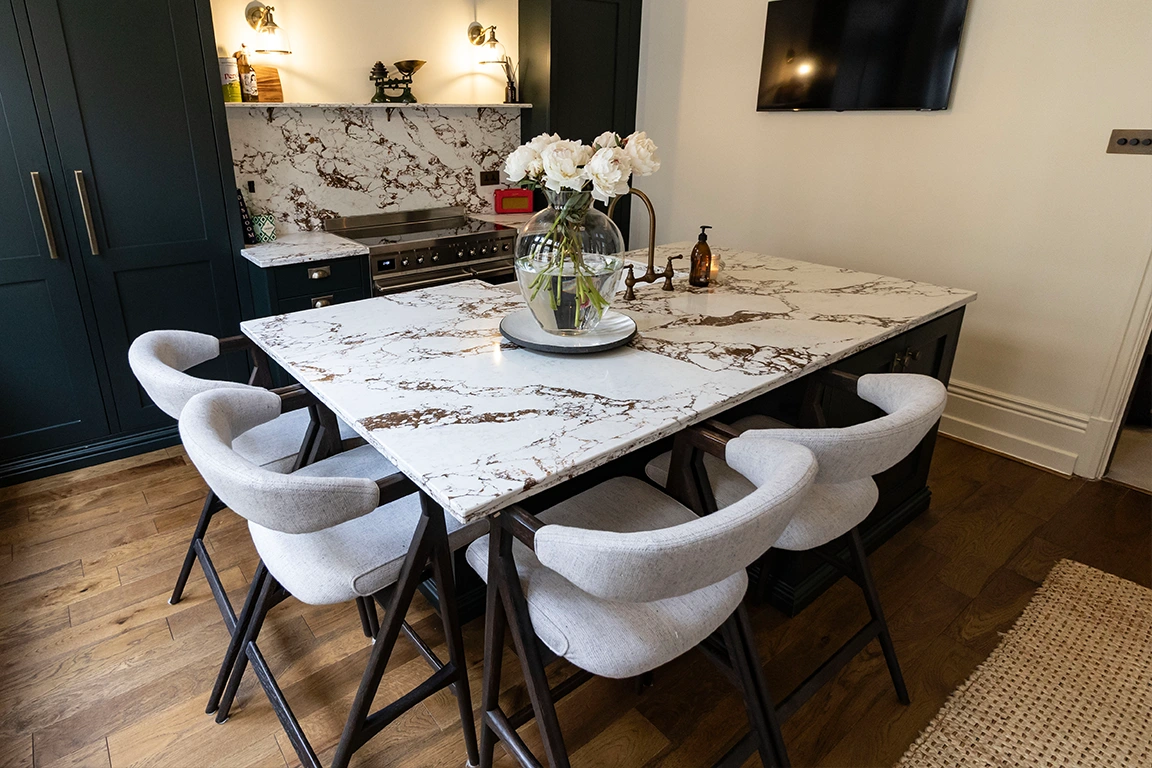
A 30mm worktop reads as more substantial. In traditional and shaker-style kitchens, which remain the most common style we template across Leeds, Bradford and the wider West Yorkshire area, the deeper edge balances the visual weight of framed doors and cornicing. A thin worktop on a classic kitchen can look slightly mean, like a good suit with the wrong shoes.
30mm also opens up the full range of edge profiles: bullnose, ogee, bevelled and deep pencil-round edges all show their shape better in thicker stone. If your design includes a feature island where the worktop is meant to be noticed, the extra 10mm carries the drama.
The trade-offs are the mirror of 20mm’s strengths: higher material cost, more weight, and slightly longer handling time during installation.
The Option Many Homeowners Never Hear About
There is a third route that good fabricators offer and price-led sellers rarely mention: a 20mm slab with a mitred, built-up edge. The fabricator bonds a strip of the same quartz beneath the front edge, creating the appearance of a 40mm, 60mm or even 100mm chunky worktop while using thinner, lighter stone.
Done well, the mitre joint is almost invisible and the veining flows continuously over the edge. Done badly, you see a hard line where the pattern breaks. This is one of those details where the skill of the workshop matters far more than the brand of the quartz, and it is worth asking any supplier to show you a finished mitred edge in person before committing.
A Quick Decision Guide
- Modern, handleless or minimalist kitchen: 20mm
- Shaker, traditional or farmhouse kitchen: 30mm
- Statement island or waterfall end panels: 30mm, or 20mm mitred
- Tight budget with no compromise on quality: 20mm
- Long unsupported overhangs: ask your fabricator, as support brackets may decide it for you
How Meridian Granite Can Help
Meridian Granite fabricates and installs both thicknesses from our workshop in Pudsey, Leeds, using our own laser templating, CNC cutting and installation teams. Our showroom holds full slabs rather than sample chips, with finished displays in 20mm, 30mm and mitred profiles, so you can stand in front of each option and judge the difference with your own eyes rather than from a photograph. After more than 15 years and over 15,000 projects across Yorkshire, our advice is straightforward: choose the thickness that suits your kitchen’s style, because the quality of the stone is equal either way.
Final Thoughts
There is no universally correct answer, only the right answer for your kitchen, your budget and your design. If you are weighing it up for a project in West Yorkshire, call in to see both thicknesses side by side. Ten minutes in front of real stone settles the question faster than any article can.